


You’re spending time and money on social media. But are you getting back more than you put in? That’s what social media ROI measurement tells you. Here’s a simple six-step process to figure it out, no fluff, just the numbers that matter.
Step 1: Define Your Social Media Goals and KPIs
Start with the business outcome you want. More sales? Brand awareness? Customer support? Each goal needs a different KPI. For sales, track conversions and revenue. For awareness, track impressions and reach. For support, track response time and satisfaction scores.
Write down three to five goals. Then pick one primary KPI per goal. This keeps your measurement focused. Without clear goals, you’re measuring everything and nothing.
If you’re not sure where to start, a structured social media marketing strategy can help you align goals with business objectives.
Step 2: Set Up Tracking and Analytics
You can’t measure what you don’t track. Start with UTM parameters for every link you share. Append `utm_source`, `utm_medium`, and `utm_campaign` to your URLs. This lets Google Analytics show you exactly which social posts drive traffic and conversions.
Next, connect your social accounts to a dashboard. Most platforms have native analytics, Facebook Insights, Twitter Analytics, LinkedIn Analytics. Pull those into a free tool like Google Data Studio or a paid one like Sprout Social. The goal: one place to see all your data.
Pro Tip: Use a naming convention for UTM tags so you can sort and filter later. For example: `social_facebook_q12026`.

Step 3: Calculate Social Media Costs
ROI needs both sides of the equation: money in and money out. Costs aren’t just ad spend. Include content creation (designers, copywriters), tool subscriptions (scheduling, analytics), and staff time (hours spent posting, engaging, reporting).
Add it all up for a month. That’s your total cost. Be honest, include everything. Hidden costs like your own time often make ROI look smaller than expected.
To get a clearer picture of how paid ads affect your bottom line, on paid social media advertising.
Step 4: Measure Revenue Attribution
Attribution answers: which social posts led to sales? Simple models use last-click: the last thing someone clicked before buying. More advanced models use multi-touch: all the touchpoints along the way.
Set up conversion tracking in Google Analytics or your CRM. Tag each conversion with the source. For ecommerce, use the built-in ecommerce tracking. For lead gen, create a goal for form submissions.
A good rule: track at least first-click and last-click. That gives you two views of the same data. Over time, you’ll see which social channels start the journey and which close it.
Step 5: Calculate ROI Using the Formula
The formula is simple: (Revenue , Cost) / Cost × 100. The result is a percentage. Anything above 0% means you’re making money. Below 0% means you’re losing it.
Example: You spent ₹50,000 on social (ads + tools + time). You tracked ₹1,50,000 in sales from social. ROI = (1,50,000 , 50,000) / 50,000 × 100 = 200%. You made back 2x what you spent.
Run this calculation monthly. Compare across channels. Facebook might give 150% ROI while LinkedIn gives 50%. Now you know where to put more budget.
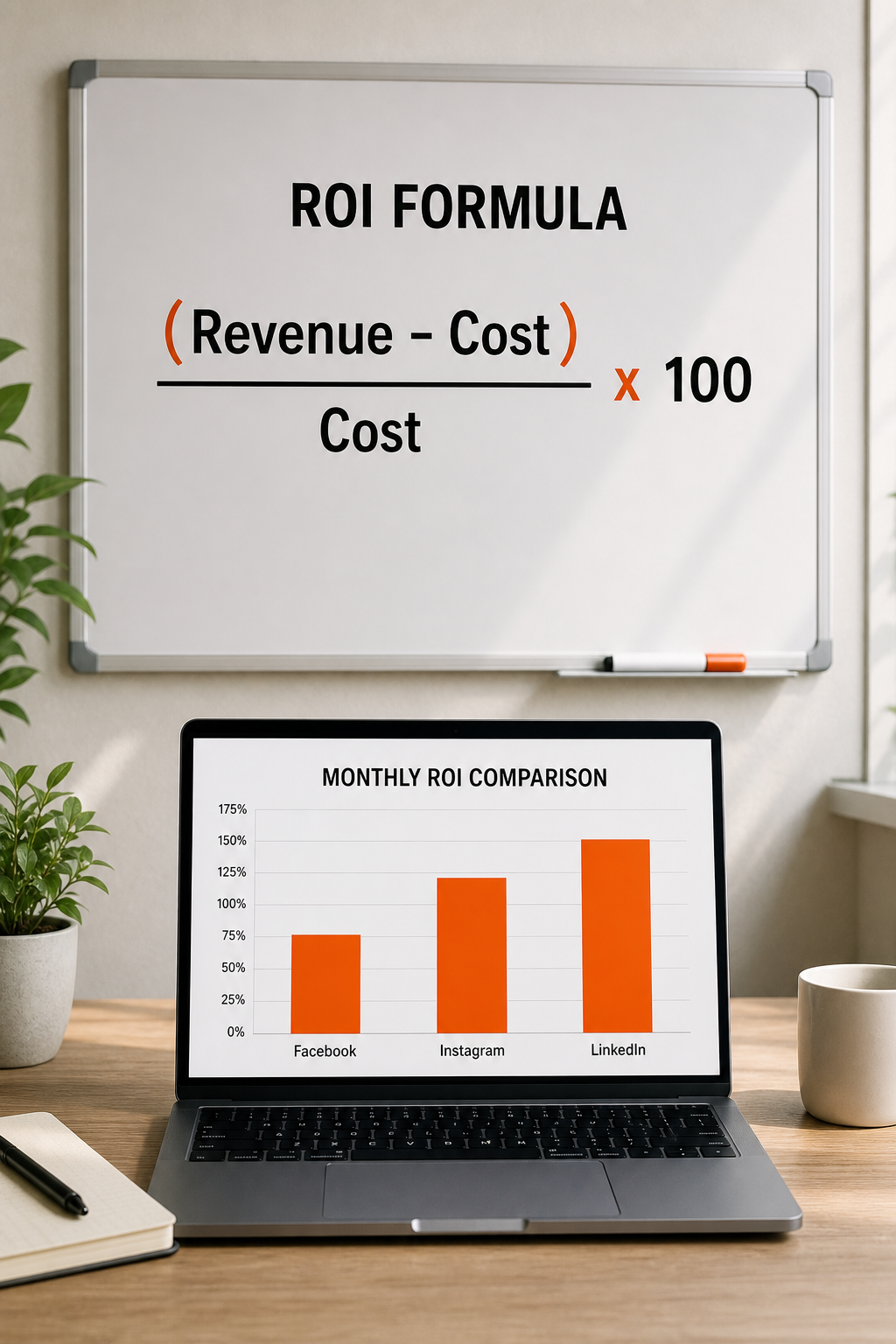
According to Wikipedia, ROI is a standard measure of profitability. Use it for any investment, including social media.
Step 6: Report and Optimize Your Strategy
Numbers don’t help if they sit in a spreadsheet. Build a monthly report that shows trends: which posts drove the most revenue, which channels had the best ROI, and how costs changed.
Present the report to your team or client. Use charts, not tables. Highlight the biggest wins and the biggest misses. Then decide: double down on what works, cut what doesn’t.
Optimization is continuous. Test new content formats, adjust ad targeting, try different posting times. Each change affects ROI. Keep measuring, keep iterating.
If you’d rather focus on running your business while experts handle the numbers, best social media marketing services in India can take over.
FAQ
What is a good social media ROI?
A good social media ROI depends on your industry and goals. For most businesses, anything above 100% (you earn back double what you spend) is solid. Compare against your other marketing channels for context.
How do you calculate social media ROI manually?
Add up all social media costs for a period. Then add up the revenue directly attributed to social. Use the formula: (Revenue , Cost) / Cost × 100. The result is your ROI percentage.
Can you measure social media ROI without sales?
Yes. If your goal is brand awareness, measure impressions, reach, and engagement. If it’s lead generation, measure form fills and email signups. ROI isn’t always revenue , define your value metric first.
What tools are best for social media ROI measurement?
Google Analytics is free and essential for tracking conversions. Native platform analytics cover basic metrics. For deeper insights, tools like Hootsuite, Sprout Social, and HubSpot integrate attribution. SocialBinge also offers custom dashboards for clients.
How often should I measure social media ROI?
Monthly is a good rhythm for most businesses. It gives you enough data to spot trends without overwhelming you. Quarterly deep dives work for long-term brand building. Always track consistently so you can compare periods.
Conclusion
Measuring social media ROI doesn’t need to be complicated. Define your goals, track everything, calculate costs and revenue, then run the formula. The real value comes from using those numbers to make better decisions. If you want a partner to do the heavy lifting, SocialBinge can help you build a data-driven social strategy that actually pays off.